Phase 4: T3 Thyroid Therapy (Rebooting Your Metabolism)
Not sure what to actually buy? See The Starter Kit, the full shopping list in protocol order.
Where T3 can actually hurt you
T3 raises your heart rate and metabolic demand. At the doses described here it is real medicine with real force behind it. These are the cases where you slow down and build the prep first, and a couple where you get my eyes on your numbers before you touch it.
Many people with chronic illness are stuck in a state where their body is “hibernating” to save energy. Even if your blood tests look normal, your body might not be using thyroid hormones correctly. This phase uses a hormone called T3 to “reboot” your body’s thermostat and turn your energy back on.
Is This Therapy Right for You?
First Gate: How Did the Fast Leave You?
The Signs I Look For
Note: If your resting heart rate is above 90 bpm, resolve that first. An elevated resting HR is a contraindication for starting T3 therapy.
Other Common Symptoms
(Check how many you have – the more you have, the more likely you need this)
- Always tired or waking up exhausted
- Brain fog, trouble concentrating, or memory loss
- Cold hands and feet even when it’s warm
- Gaining weight easily or unable to lose it
- Dry skin or hair that is thinning/falling out
- Feeling low, anxious, or irritable
- Muscle and joint aches
- Frequent headaches or swelling (fluid retention)
Quick Check:
Metabolic slowdown after the fast + Low Morning Temp + Low Pulse + 3 or more symptoms → You may be a good candidate for T3 therapy.
Track your temp and pulse for one week to be sure.
Order note: fast first, always. T3 before the fast is only for the person who has struggled with fasting, pushed through it, kept getting worse with signs of metabolic trouble, and needs a jump start. That is a decision to make with me, not from a chart.
Getting an Accurate Temperature Reading
Use a Basal Body Thermometer, Not a Standard One
Your waking temperature is one of the most important data points in this entire protocol. A cheap drugstore thermometer that reads to one decimal place is not good enough. You need a thermometer precise enough to detect meaningful shifts, the kind used for tracking fertility windows.

A digital basal body thermometer that reads to two decimal places and holds the result for easy reading
Introduction to T3 Therapy
Overview: This therapy uses T3 (thyroid hormone) to help with fatigue and low body temperature. The goal is to “restart” your metabolism. You can dive deeper into it on this site: wilsonssyndrome.com
The Best Way: Slow-Release T3 (SR-T3)
I strongly recommend using Slow-Release T3 (SR-T3).
- Why? It keeps your hormone levels stable all day and night. It doesn’t cause sudden spikes like regular T3.
- Evening Use: You can take it in the evening to help your metabolism while you sleep.
- Easier to Use: You don’t have to keep taking small doses throughout the day.
Where to Get T3
My recommendations, in this order:
- A prescription first. A doctor who will write for T3, ideally compounded slow-release T3, is the first choice. Most doctors will not, so if yours will, take that route.
- chronic-illness.st for slow-release T3 when the prescription route is closed. They specialize in this medication and can ship to many places. (Previously chronic-illness.ca, the site has recently migrated.)
- IdeaLabs Tyronene (T3) or Tyromix (T3 plus T4) as the third option. Both are immediate-release, so they are dosed more often through the day, and the stepwise ramp on this page is written for slow-release only.
If you have trouble getting your medication, I can help you find a way to get what you need.
Why Your Blood Tests Might Lie to You
The Real Problem: Tissue-Level Resistance
Most doctors look at your blood to see if you have enough T3. But just because T3 is in your blood doesn’t mean it’s getting inside your cells where it’s needed. This is called tissue-level resistance.
Side-by-side: the same lab result, two completely different cellular realities. This is why “your labs are normal” is not the answer chronic illness patients need.
Think of T3 as a “key” and your cells as “doors.” In many sick people, the locks are jammed. The T3 keys are floating around in the hallway (your blood), but they can’t get into the rooms (your cells) to turn on the power. When a doctor draws your blood, they see plenty of keys and say, “You’re fine!” Even though your body is actually starving for energy.
Brain Insulin Resistance
This problem is especially serious in the brain. When T3 can’t get into your brain cells correctly, it leads to a type of “brain insulin resistance.” This causes major brain fog, memory problems, and severe fatigue. Even if you eat enough food, your brain can’t use that energy properly without the T3 “key” to unlock the process.
Other Signs of Resistance:
- Low Body Temperature: If your cells don’t have enough T3, they can’t create heat. This is why you feel cold even if your blood tests are “normal.”
- High Reverse T3: Sometimes your body makes a “fake key” called Reverse T3 that blocks the real T3 from working.
- Adrenal Stress: When your cells are starving for energy, your body pumps out stress hormones (like cortisol) to try to keep you going. This eventually leads to total burnout.
T3 therapy is used to “electrify” the body, sending a structured “electrical signal flood” of abundance and shock to finally force those jammed locks open and wake your body up. This convinces the cells that T3 can enter again and radically increases insulin sensitivity. Depending on the case, this may require a mix of T4 and high T3, or just T3, but the concept of a short, powerful energy burst remains the same. Do not forget to understand the critical co-factors required for T3 therapy to be safe and effective.
The Role of Genetics: In some cases, your genetics can play a big role in how your body handles T3. Fasting, stress, and low-carb can have different effects on different people. To learn more about this, visit the Genetic Polymorphisms page.
When to Start T3: After the First 7 Days of Refeeding
Finish the Fast First. T3 Starts After 7 Days of Refeeding.
In the Scorch Protocol, T3 does not run during the fast. You finish the whole fast, the dry fast first and then the water fast, with no T3 on board. The fast is doing its own work: clearing damaged cells, draining the viral reservoir, resetting insulin signaling. Loading a metabolic accelerant on top of that while zero calories are coming in is how you burn muscle and stress the heart for nothing. Let the fast finish clean.
What you do carry straight through the fast-to-refeed transition is your viral reactivation protocol. L-lysine comes back on water day 1 and monolaurin and olive leaf come in with the first meal, holding the natural line. Valacyclovir joins as the standing antiviral backbone on refeed day 3 at the earliest (never during the fast, dry or water, since a water fast still leaves the body dehydrated and the drug is renally cleared), with ivermectin alongside it as supportive coverage plus the primary antiparasitic, and a valacyclovir loading dose layered on top if you feel a prodrome coming on once the course is running. None of it pauses once the standing course is running. That handoff from fasting to eating is the exact energetic trough where dormant herpesviruses wake up, so the antivirals stay on through the transition and across the entire refeed. Do not drop them the moment you start eating.
The 30-Day T3 Course
This course is designed to wake up your body’s metabolism, and its shape is not mine. The pattern comes from Wilson’s Temperature Syndrome protocol: you ramp the dose until your waking temperature reaches the target, you hold it there, you taper off, and you allow your own system to come back. I will be straight about what stands behind it. The published evidence for Wilson’s protocol itself is a single uncontrolled series of eleven patients (Friedman 2006), and mainstream endocrinology does not recognise the syndrome (the American Thyroid Association statement; McDermott 2024). The stronger ground for using T3 in people like us is the low-T3 pattern measured in chronic fatigue patients against matched controls (Ruiz-Nunez 2018) and the muscle changes after weight loss that T3 repletion reversed (Rosenbaum 2018). The shape is the rule. The increments, the length of the hold and the pace of the taper are set per case against your waking temperature and resting heart rate, so treat the example below as one way a slow-release ramp can look, not as a schedule to copy.
What the Evidence Says About This Course
The one controlled trial that gave T3 around a fast, restoring it to the normal range over the last three days of a ten-day fast, did not raise metabolic rate (Byerley and Heber 1996), and in an earlier 80-hour fast T3 replacement increased urea loss, which the authors read as the low-T3 state of fasting protecting muscle (Gardner 1979). Nobody has tested T3 at these doses after a refeed, so the course is my clinical practice, not a tested protocol. The taper is the part that needs the most care: when thyroid hormone is withdrawn, the pituitary stays quiet for about two weeks, the T3 response takes about three weeks to normalise, and after longer suppression T4 took at least four weeks to return (Krugman 1975; Vagenakis 1975). That lag is why the taper is slow and why I watch the trough, and it runs longest in anyone already on thyroid medication (see Safety First below). Marked caveat: those withdrawal studies were done at replacement-scale doses in people whose axis was structurally normal; nobody has published the recovery curve after a course like this one.
| Phase | Time | What to Do |
|---|---|---|
| The Ramp | Until your waking temperature reaches target | The Hike Up: Raise the total daily dose in steps until your waking temperature sits in the 36.5 to 37.0°C (97.7 to 98.6°F) band. Example only: a slow-release ramp in 15 mcg steps, split morning and evening, is one shape this can take. Stop climbing the moment resting heart rate passes 100 bpm, whatever the dose. |
| The Hold | Until the temperature holds | Stay at the dose that holds the target to “break” your metabolism’s resistance. If your heart races or you feel anxious, you have gone past your dose; come back down a step. |
| The Taper | Set per case | The Hike Down: Step the dose down to zero. This lets your thyroid start making its own hormones again without a crash. Watch the taper trough: it is where people who were already on thyroid medication struggle most (see Safety First below). |

Figure 1: a worked example of one ramp, hold and taper. The Wilson’s shape is the rule; the day counts and doses in the chart are not.
Safety First
What the evidence says: the axis-recovery studies ran longest in people who were hypothyroid before treatment, with the pituitary taking roughly a month to respond fully (Krugman 1975), and a 2021 systematic review of patients taken off thyroid hormone found that those with a prior diagnosis of overt hypothyroidism were markedly less likely to stay euthyroid off it than those who had only subclinical hypothyroidism (Burgos 2021). My experience of this trough runs the same direction as that evidence. Marked caveat: the review grades its own evidence as low quality, and none of it was collected after a T3 course like this one.
Drug Interactions You Need to Know About
Thyroid can thin blood, especially at higher doses. Patients on warfarin sodium (Coumadin®) or other anticoagulants may develop an increase in prothrombin time requiring a lowering of their anticoagulant therapy while taking thyroid medication. Drug-drug interactions may occur with other anticoagulants, oral hypoglycemic agents (increased requirements), insulin (increased requirements), estrogens and oral contraceptives (increased thyroid requirement), tricyclic antidepressants (enhanced effects), cardiac glycosides (potential toxicity and reduced dose) and cholestyramine (decreased T3 and T4 absorption). Several drugs, including cimetidine, ranitidine, glucocorticoids, amiodarone and beta-receptor antagonists, have been reported to increase the hepatic metabolism of T4 into reverse T3 by inhibiting 5’-desiodinase, the hepatic microsomal enzyme catalyzing the conversion of T4 into T3.
Keeping Your Progress
- Supplements: Take B-Complex vitamins, Vitamin C, and electrolytes to help your body.
- Diet: Eat plenty of protein to keep your metabolism strong.
- Bone Health: Take Vitamin K2 to keep your bones healthy during this therapy.
- Success: When you are finished, your waking temperature should stay between 36.5°C and 37.0°C (97.7°F - 98.6°F) without any medicine.
- What comes next: A cycle is a fast, a refeed and this 30-day course. Seven days after the course ends, the next fast opens. If the course did little for you, wean off and you bounce back; that result tells me something too. hGH is not the next step by default: it enters around the third cycle, on top of T3, only when two cycles of fasting plus T3 have not done enough. See the hGH Therapy page.
The Co-Factor Stack That Makes T3 Stick
T3 reboots metabolism, but whether it holds depends on three things going right at the same time: you have to eat enough, you have to sleep, and your stress hormones have to come down instead of spiking. The protocol uses a small co-factor stack to protect all three.
None of these replace T3. They are what keep T3 working long enough to reset your baseline.
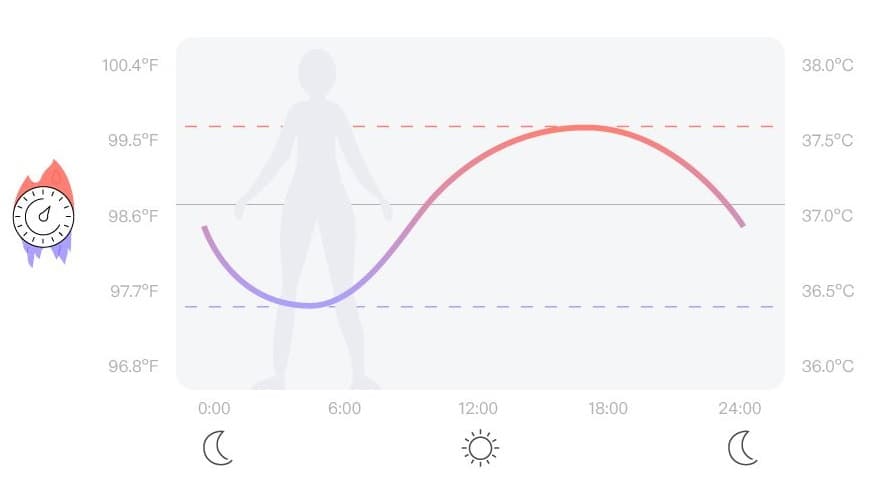
Figure 2: The ideal body temperature curve of a healthy person, rising through the day and peaking in the late afternoon. If your T3 therapy works, your temperature pattern should begin to match this curve.
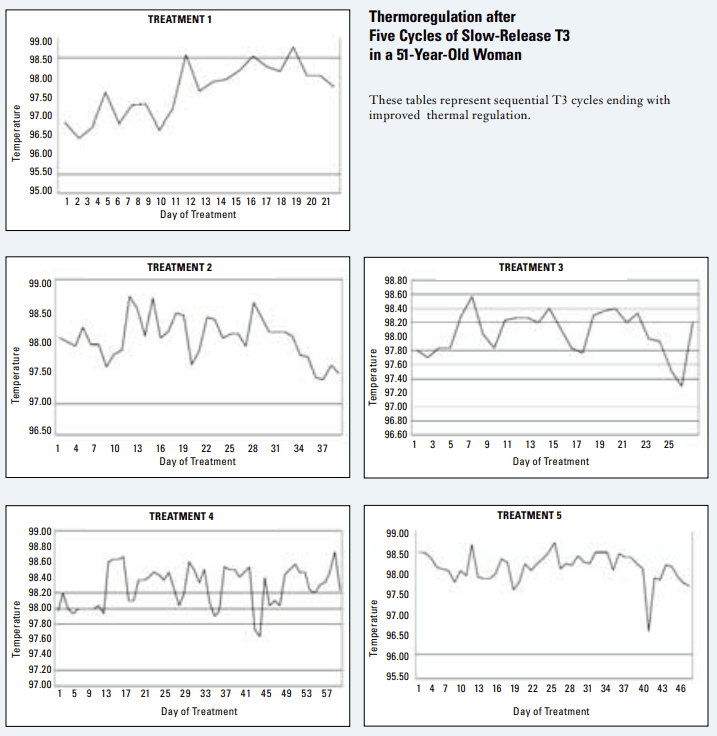
Figure 3: Real-world thermoregulation data across five cycles of slow-release T3 in a 51-year-old woman. Each cycle progressively lifts the waking temperature baseline toward the healthy 36.5 to 37.0°C range shown in Figure 2, the pattern most participants follow when the protocol is working.
Fueling T3 Therapy: Why Calories Matter Here
T3 dramatically increases your metabolic rate. That is the point. But a faster metabolism with insufficient fuel will cannibalize muscle. You must not be in a caloric deficit during this phase.
- hGH: directly shifts the body toward anabolism and preferential fat use, reducing the rate at which muscle is burned for fuel even when calories are temporarily low. It is an add-on to the T3 cycle, normally from around the third cycle, once two cycles of fasting plus T3 have shown they are not enough on their own.
- Retatrutide: a GLP-1/GIP/glucagon triple agonist that improves glucose utilization and raises baseline energy availability. The glucagon component is particularly useful for people stuck in low-energy states.
- Cyproheptadine: the primary first-cycle lever for filling the eating window when appetite is broken or the gut is hypersensitive. It restores the drive to eat, calms the brain-gut nerves that make large meals nauseating, and deepens sleep when repair on T3 happens. For many people this is the single cheapest way to get calories back up early in the refeed. It is introduced in the first cycle, but it does not have to stop when hGH begins: see the cyproheptadine and hGH note.
Get your own customized refeed plan
Members build a personalized, day-by-day refeed plan: food choices and a calorie ramp sized to their own fast, plus when to layer in T3 and the rest of the protocol.
Build your refeed plan →Can't actually get slow-release T3?
This is the wall almost everyone hits. Most doctors will not prescribe slow-release T3, so if yours will, take that route first. The peptide and hGH markets are full of fakes. Inside the members portal I share my current, personally verified supplier contacts for slow-release T3, peptides, hGH, and cyproheptadine, plus exactly what to order and how to dose it, worked out with you directly.
How the members portal works →Have a question about your own case?
Ask Yannick directly. Members send their labs, symptoms, and questions and get a personal, reviewed answer, plus help sourcing medication and the full synthesized protocol behind every reply.
Ask Yannick your question →References
- Cahill GF Jr. Starvation in Man. New England Journal of Medicine, 1970.the fasting-metabolism timeline: the brain's shift to ketones and muscle sparing once ketosis is established, and why T3 must be paired with adequate fuel
- Influence of absolute (dry) fasting on metabolic processes and organ function.profound insulin suppression and improved insulin sensitivity (HOMA-IR) during fasting
- Friedman M, Miranda-Massari JR, Gonzalez MJ. Supraphysiological cyclic dosing of sustained release T3 in order to reset low basal body temperature. P R Health Sci J, 2006;25(1):23-29. PMID 16883675.the only published clinical study of the Wilson's T3 protocol: eleven chronic fatigue patients, no control group, no blinding; the entire published base for the cycling pattern this course borrows
- American Thyroid Association. Statement on "Wilson's Syndrome." Updated 24 May 2005.the mainstream position: the syndrome is not recognised and T3 given this way can raise blood T3 to abnormal levels with potential effects on heart and bone
- McDermott MT. Pseudo-endocrine Disorders: Recognition, Management, and Action. J Endocr Soc, 2024;9(1):bvae226. PMID 39749108. DOI 10.1210/jendso/bvae226.a 2024 endocrine review that classes Wilson's syndrome among pseudo-endocrine disorders and names high-dose T3 as the hazard
- Ruiz-Nunez B, Tarasse R, Vogelaar EF, Janneke Dijck-Brouwer DA, Muskiet FAJ. Higher Prevalence of "Low T3 Syndrome" in Patients With Chronic Fatigue Syndrome: A Case-Control Study. Front Endocrinol (Lausanne), 2018;9:97. PMID 29615976. DOI 10.3389/fendo.2018.00097.chronic fatigue patients against matched controls: similar TSH, lower free T3 and total T3, more reverse T3; the authors call for trials of T3
- Rosenbaum M, Goldsmith RL, Haddad F, et al. Triiodothyronine and leptin repletion in humans similarly reverse weight-loss-induced changes in skeletal muscle. Am J Physiol Endocrinol Metab, 2018;315(5):E771-E779. PMID 29920214. DOI 10.1152/ajpendo.00116.2018.T3 repletion reversed the skeletal muscle efficiency changes that follow weight loss, at replacement scale
- Byerley LO, Heber D. Metabolic effects of triiodothyronine replacement during fasting in obese subjects. J Clin Endocrinol Metab, 1996;81(3):968-976. PMID 8772559. DOI 10.1210/jcem.81.3.8772559.T3 restored to the normal range over the last three days of a ten-day fast did not raise metabolic rate; replacement dosing during the fast, not this protocol's post-refeed timing, which nobody has tested
- Gardner DF, Kaplan MM, Stanley CA, Utiger RD. Effect of tri-iodothyronine replacement on the metabolic and pituitary responses to starvation. N Engl J Med, 1979;300(11):579-584. PMID 105290. DOI 10.1056/NEJM197903153001102.in an 80-hour fast, T3 replacement raised urea excretion; the authors read the low-T3 state of fasting as protecting muscle protein
- Krugman LG, Hershman JM, Chopra IJ, et al. Patterns of recovery of the hypothalamic-pituitary-thyroid axis in patients taken off chronic thyroid therapy. J Clin Endocrinol Metab, 1975;41(1):70-80. PMID 807596. DOI 10.1210/jcem-41-1-70.after withdrawal, TSH stayed suppressed about two weeks and the T3 response normalised at about three weeks; previously hypothyroid patients took about a month
- Vagenakis AG, Braverman LE, Azizi F, Portnay GI, Ingbar SH. Recovery of pituitary thyrotropic function after withdrawal of prolonged thyroid-suppression therapy. N Engl J Med, 1975;293(14):681-684. PMID 808728. DOI 10.1056/NEJM197510022931402.after prolonged suppression, TSH returned at two to three weeks and serum T4 normalised at four weeks or more
- Burgos N, Toloza FJK, Singh Ospina NM, et al. Clinical Outcomes After Discontinuation of Thyroid Hormone Replacement: A Systematic Review and Meta-Analysis. Thyroid, 2021;31(5):740-751. PMID 33161885. DOI 10.1089/thy.2020.0679.patients with a prior diagnosis of overt hypothyroidism were markedly less likely to remain euthyroid off treatment than those with subclinical hypothyroidism; low-quality evidence by the authors' own grading
See the full research & citations page for the complete evidence base and how each study is used.